Don't take your indoor air for granted. The same invisible particles, plus the stale air that builds up in a January house with every window shut, change what your family breathes long before you'd ever notice.
So is a monitor worth the money? For a lot of Wisconsin households, yes. You just need to know what it can and can't tell you. A good monitor makes the invisible visible. It shows you when smoke slips indoors, when heating-season air goes stale, and when it's time to open a window or check your filter. What most models won't catch is radon, one of the biggest indoor air risks in the state.
TL;DR Quick Answers
Air Quality Wisconsin
On most days, Wisconsin’s outdoor air rates are good or moderate. Wildfire smoke and summer ozone along Lake Michigan can still push readings into unhealthy territory, and that air doesn’t stay outside. Check the live AQI before you open the windows. Radon, an indoor risk, never shows up on an outdoor map.
Check it live: AirNow and the Wisconsin DNR post updated AQI readings throughout the day.
Biggest spikes: Canadian wildfire smoke pushed fine-particle AQI to 163 in Ozaukee County in June 2025.
Ozone hot spots: The Lake Michigan shoreline is the one area of the state still missing the federal ozone standard.
Indoor blind spot: About 1 in 10 Wisconsin homes has elevated radon, and outdoor AQI doesn’t measure it.
AQI above 100: Close the windows, switch your thermostat fan to “on,” and check your HVAC filter.
Top Takeaways
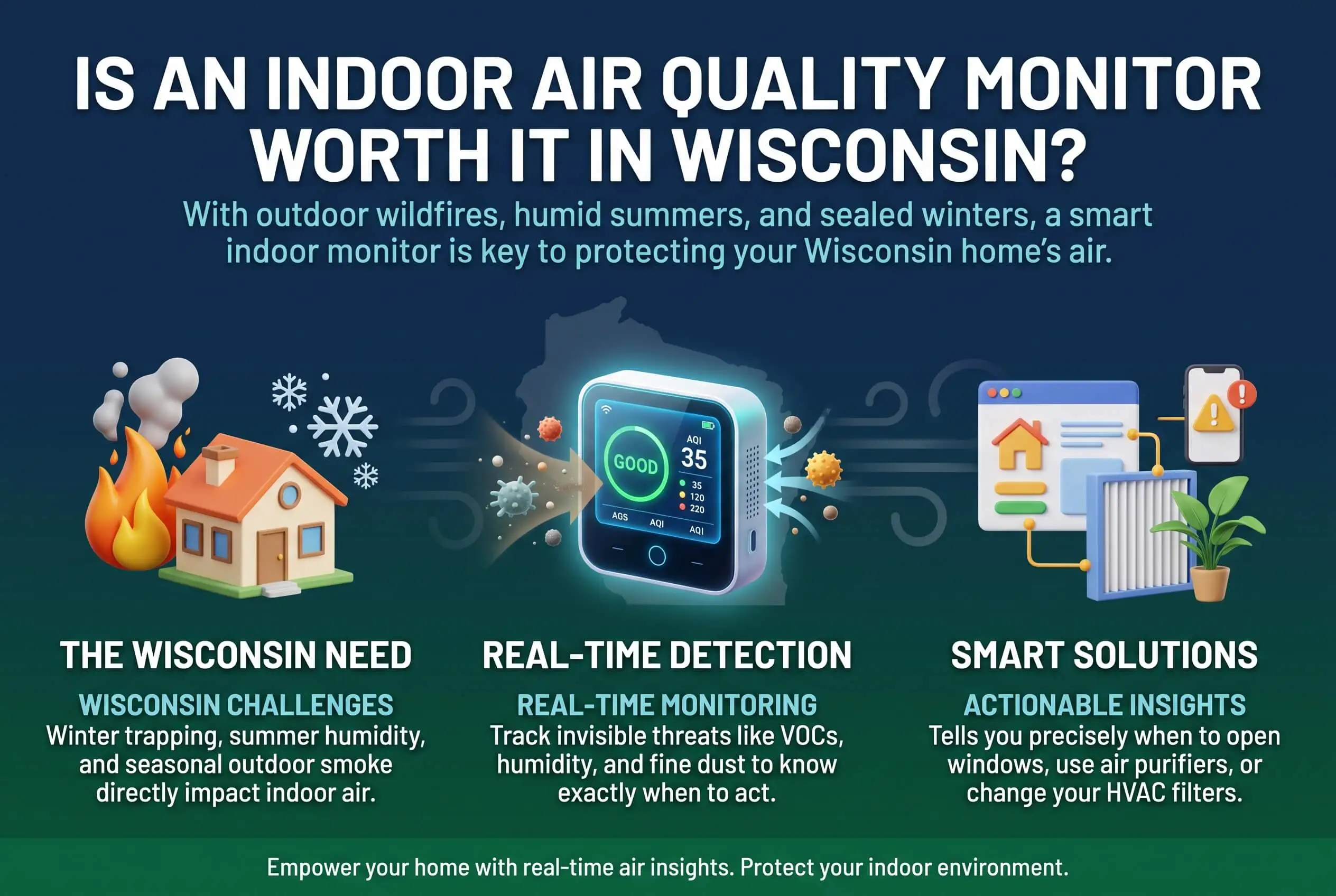
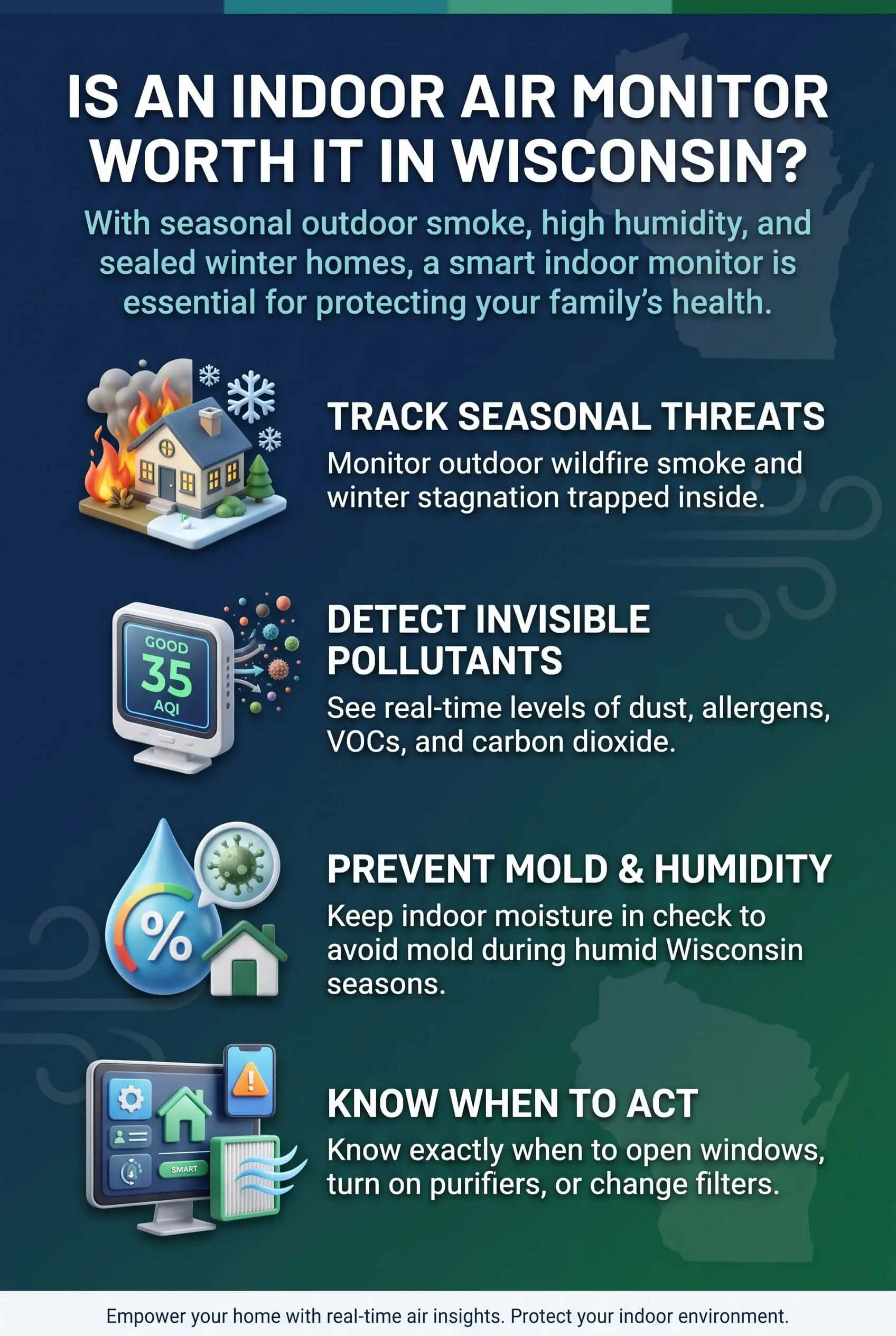
A monitor makes the invisible visible, tracking PM2.5, CO2, VOCs, and humidity so you know when to act.
Wisconsin raises the stakes with wildfire smoke, lakeshore ozone days, and months of closed-up winter air.
Radon is the blind spot. About 1 in 10 Wisconsin homes has elevated levels, and most monitors can't detect it.
Watch the trends over the decimals. Consumer sensors vary in accuracy, yet their spikes and patterns still tell you plenty.
Your response does the work. Ventilation, better filtration, and testing are what turn readings into cleaner air.
What an Indoor Air Quality Monitor Actually Measures
Most home monitors track the same core readings:
Fine particles (PM2.5): smoke, cooking particles, and dust small enough to reach deep into your lungs.
Carbon dioxide (CO2): a handy signal of how fresh or stale the air in a room has become.
Volatile organic compounds (VOCs): gases from cleaners, paint, new furniture, and air fresheners.
Humidity and temperature: the moisture and comfort readings behind mold risk and winter dryness.
Radon and carbon monoxide sit outside that list. Most all-in-one monitors measure neither, so you'll still want a radon test and a working CO alarm.
Why Air Quality in Wisconsin Matters Indoors
Your house breathes. Outdoor air drifts in around doors, through window frames, and straight through your HVAC system, which means today's outdoor reading is the starting point for the air in your living room. I'd make a habit of checking the live air quality in Wisconsin before you open the windows. Your monitor then shows you how much of it actually got inside.
Wisconsin brings a few pressures all its own.
Wildfire Smoke Seasons
Canadian wildfire smoke now shows up most summers. During the June 2025 event, southeastern Wisconsin logged unhealthy fine-particle readings, and the Wisconsin DNR issued soot advisories for 39 counties. Particles that small slip through the everyday gaps in any house.
Lakeshore Ozone
Along Lake Michigan, Milwaukee and Ozaukee counties still have trouble meeting the federal ozone standard. Ozone mostly stays an outdoor concern. Those hot, stagnant days, though, usually mean closed windows and an HVAC system moving every breath of air in the house.
Long, Closed-Up Heating Seasons
Winter keeps Wisconsin windows shut for months. CO2 and VOCs creep up, and the air dries out. Your monitor tells you when a few minutes of fresh air or a humidifier would make a noticeable difference.
The Radon Gap Most Monitors Miss
This one catches a lot of homeowners off guard. About 1 in 10 Wisconsin homes has elevated radon, and Wisconsin DHS says the gas turns up all over the state. You can't smell it or see it. It seeps up through foundations, and levels tend to climb in winter when everything is sealed tight.
Most popular air quality monitors can't read it. If you buy one, pair it with a short-term radon test kit or a dedicated radon detector. Wisconsin DHS recommends mitigation when a test comes back at 4 pCi/L or higher.
Where Monitors Fall Short
I'll be straight with you about the limits. Consumer monitors help, but nobody builds them to lab-instrument standards. A 2023 study in Sensors and Materials found low-cost particle sensors less reliable indoors than outdoors, and humidity, placement, and temperature can all throw readings off. The EPA points out that most of these devices have no widely accepted indoor performance standards at all.
That still leaves them plenty useful. Watch the trends. When the number jumps as you sear a steak or as smoke rolls in, that jump tells you something true, even if the exact figure runs a little high or low.
Who Gets the Most Value From a Monitor
A monitor pays off fastest in homes with:
Someone managing asthma, allergies, or another respiratory condition
A wood stove, fireplace, or gas range
A newer, tightly sealed build that trades less air with the outdoors
An address in southeastern Wisconsin or along the Lake Michigan shoreline
A family that wants to know when smoke season reaches the living room
None of those sound like your house? A radon test, a CO alarm, and regular filter changes may cover most of what you need.
What to Look for Before You Buy
A laser-based PM2.5 sensor for smoke and fine dust.
A true NDIR CO2 sensor. Skip models that report "eCO2," which they estimate from VOC readings.
Humidity and temperature readings for dry winters and damp summers.
Data history and alerts, so you see patterns over days instead of one-off snapshots.
Calibration or sensor-life details published by the manufacturer.
Radon capability, or a plan to test for it separately.
How to Act on What Your Monitor Tells You
A number on a screen only helps if it changes what you do. Here's how I'd respond to each reading:
PM2.5 climbing: shut the windows, switch your thermostat fan from "auto" to "on," and check your HVAC filter sooner than you normally would. A higher-efficiency filter, such as MERV 11 or MERV 13 if your system supports it, traps more fine particles. This breakdown of how furnace filters improve indoor air quality explains why.
CO2 above about 1,000 ppm: many people use that as the line for stuffy air. Crack a window or run the kitchen or bathroom exhaust fan for a few minutes.
Humidity under 30 percent in winter: a humidifier helps, but keep levels below about 50 percent so you don't invite condensation and mold.
VOCs spiking: open things up while you clean, paint, or cook, and keep solvents out of the living space.
"In my experience, the first sign that smoke has reached a Wisconsin home usually isn't the smell. It's a one-inch filter that goes gray in days instead of weeks, because the blower drags fine particles through it on every cycle. A monitor helps homeowners spot that early. The filter is what actually pulls those particles out of the air."
7 Essential Resources
NOAA National Weather Service: Why Air Quality Is Important: how ozone and fine particles affect your health, plus daily forecast guidance.
Wisconsin DNR: Air Quality Trends: official state monitoring data and county-by-county trend reports.
AirNow: AQI Basics: what each AQI color means and who should change plans at each level.
American Lung Association: State of the Air: yearly ozone and particle grades for Wisconsin counties.
CDC: Air Quality: health guidance for kids, older adults, and anyone living with asthma.
EPA: Low-Cost Air Pollution Monitors and Indoor Air Quality: the agency's own take on what home monitors do well and where they fall short.
American Cancer Society: Radon and Cancer Risk: why radon matters and how to test your home.
Trusted resources from NOAA, Wisconsin DNR, AirNow, CDC, EPA, and leading health organisations can help Wisconsin families understand air quality risks, monitor pollution levels, and make informed decisions. Along with checking AQI readings and testing for radon, using high quality filters can help reduce airborne particles and improve indoor air quality.
3 Statistics
About 1 in 10 Wisconsin homes has elevated radon, and the state ties roughly 962 lung cancer deaths a year to it. (Wisconsin Department of Health Services)
Air quality monitors at Harrington Beach State Park recorded an AQI of 163 for fine particles during the June 2025 wildfire smoke event, well inside the unhealthy range. (Wisconsin Public Radio)
Researchers found low-cost PM2.5 sensors unreliable indoors when they compared them against a reference analyzer using EPA guidelines, and humidity was one of the factors throwing readings off. (Sensors and Materials, 2023)
Final Thoughts and Opinion
I think an indoor air quality monitor earns its place in a Wisconsin home when you use it to make decisions. Nobody designed these units to work as safety alarms. Where they shine is catching what you'd otherwise miss, like smoke creeping in on a hazy afternoon or CO2 stacking up in a closed bedroom by February.
The trouble starts when people expect one gadget to cover everything. It won't see radon, and it can't stand in for a CO alarm. Your protection comes from what you do with the readings, whether that means opening a window, upgrading your filter, or testing for the gas your monitor can't detect.
You're the one keeping your household's air in check, and a monitor hands you better information to do it. If your home fits the profile above, I'd call it money well spent. If it doesn't, start with a radon test and a good filter, consider insulation installation to help reduce unwanted outdoor air infiltration, then come back to the monitor question later.
Frequently Asked Questions
Do indoor air quality monitors detect radon?
Most don't. Popular all-in-one monitors track particles, CO2, VOCs, and humidity, while radon calls for a dedicated detector or a test kit. Since radon shows up all over Wisconsin, testing for it separately is the safest move.
Is the air quality in Wisconsin bad enough to need a monitor?
On most days, Wisconsin's outdoor air rates are good or moderate. The exceptions are what count, and in Wisconsin that means wildfire smoke, summer ozone along Lake Michigan, and long, closed-up winters. A monitor shows you how those swings play out inside your own home.
Where should I place an air quality monitor in my home?
Put it where your family spends the most time, usually the living room or a bedroom, at about breathing height. Keep it a few feet from windows, vents, and the stove so one source doesn't skew every reading.
Can a monitor tell me when to change my HVAC filter?
Indirectly, yes. If indoor PM2.5 stays high with the windows closed, or climbs every time smoke rolls in, take that as your cue to pull the filter and look. Keep following your filter's recommended replacement schedule too.
How accurate are home air quality monitors?
Accuracy depends on the brand and the sensor inside. A 2023 study in Sensors and Materials found low-cost particle sensors can drift indoors, especially when humidity runs high. Use the readings to compare changes over time and treat the exact numbers as estimates.
Decide If a Monitor Is Worth It for Your Wisconsin Home
A monitor is worth it when it changes what you do, from shutting the windows on smoky days to testing for the radon it can't see. Check today's outdoor air, test your home for radon, choose the best air filter for your home to help reduce airborne particles, and let the readings guide your family's next step.