The sky over Bde Maka Ska can look spotless at 7 a.m. and carry a brownish haze by 4 p.m., and the forecast you read over breakfast won't always see that shift coming.
Don't take that morning number for granted. The air quality index (AQI) for Minneapolis updates every hour, which makes the most protective habit you can build one of the easiest, too. Check the reading within an hour of heading out. Notice which way it's moving, then match it to how long you'll actually be outside.
TL;DR Quick Answers
AQI Minneapolis
The Minneapolis AQI updates every hour, but the current number is a NowCast that blends the past 12 hours, so it can trail fast-arriving wildfire smoke. Check it within an hour of heading out, watch whether the last three readings are climbing, and move plans indoors at 101 if you’re in a sensitive group.
Updates: Every hour, from MPCA and AirNow monitors.
Sensitive groups act at: 101, the orange category. That includes kids, older adults, and anyone with asthma or heart disease.
Everyone acts at: 151, the red category.
Biggest hourly swings: Afternoon ozone from late May through August, rush-hour exhaust near I-35W and I-94, and wildfire smoke at any hour.
Best summer window: Mornings, before ozone builds.
Smoke-day move indoors: Close windows, set the thermostat fan to “on,” and run a MERV 13 filter if your system can handle it.
Fastest alerts: MPCA email alerts and the AirNow app.
Top Takeaways
The Minneapolis AQI updates every hour, so check it within an hour of heading out.
The current number is a NowCast, which can lag behind sudden smoke and stay high after the air clears.
Three readings in a row tell you far more than one.
Summer mornings usually run cleaner, but fine particles can spike at any hour.
Size your plans to your time outside, and set alerts so bad-air days find you first.
Why the Minneapolis AQI Changes From Hour to Hour
Every hour, the Minnesota Pollution Control Agency (MPCA) turns its latest monitor readings into a fresh AQI value. In the Twin Cities, that number usually moves for one of four reasons.
Afternoon ozone. Hot, sunny days from late May through August build ozone through the afternoon, and it lingers into early evening. Mornings run cleaner and cooler.
Rush-hour exhaust. Fine particles pile up along I-35W and I-94 during both commutes.
Still, frigid nights. Winter calm can trap wood smoke and furnace exhaust near the ground overnight and into the morning.
Wildfire smoke. Plumes from Canadian and western fires don't keep a schedule, and a wind shift can carry them in at any hour.
That last one is why a single morning glance won't cut it during smoke season.
What the Hourly Number Shows: NowCast Explained
The "current" AQI you see on AirNow, in the AirNow app, and in many real-time alerts is a NowCast, an EPA method. Officially, the daily AQI for fine particles is a 24-hour average, and that average isn't complete until the day ends. NowCast gets around that by blending the past 12 hours of readings into one estimate for right now.
The blend adjusts as conditions change. On steady days, each of those 12 hours counts about the same. When readings swing fast, the newest hour carries roughly half the weight and the older ones fade quickly, so the number catches up fast without ever being truly instant.
On the ground, that plays out two ways. When smoke rolls in suddenly, the hourly AQI can lag behind what your eyes and nose already know. After a front sweeps through, the number may stay high for a while under a clear blue sky. If you can see haze or smell smoke, believe it and treat the trend as rising. A clear grasp of AQI meaning helps you track these changes and make safer decisions when air quality shifts throughout the day.
How to Check Hourly AQI Changes Before You Go Out
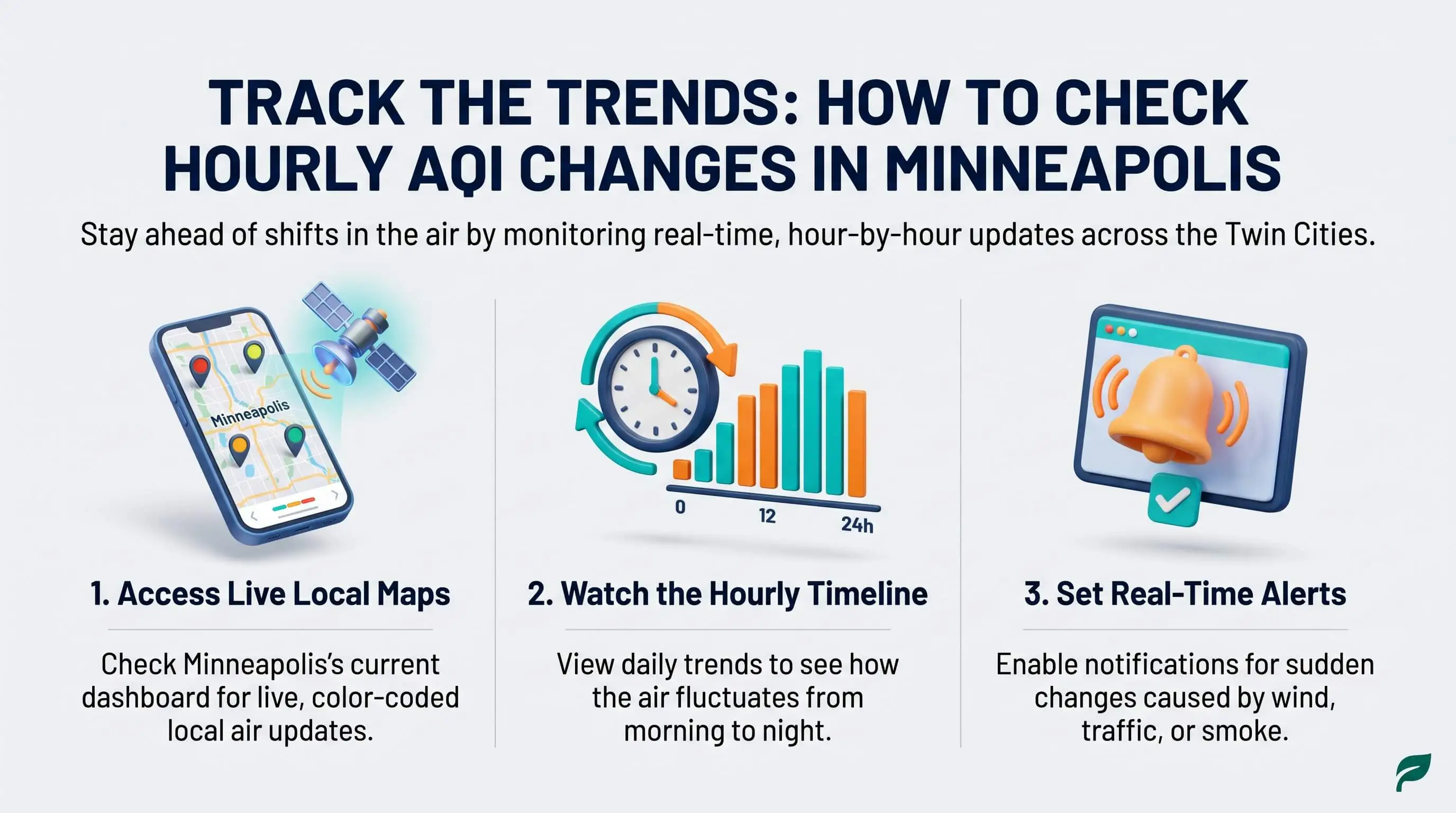
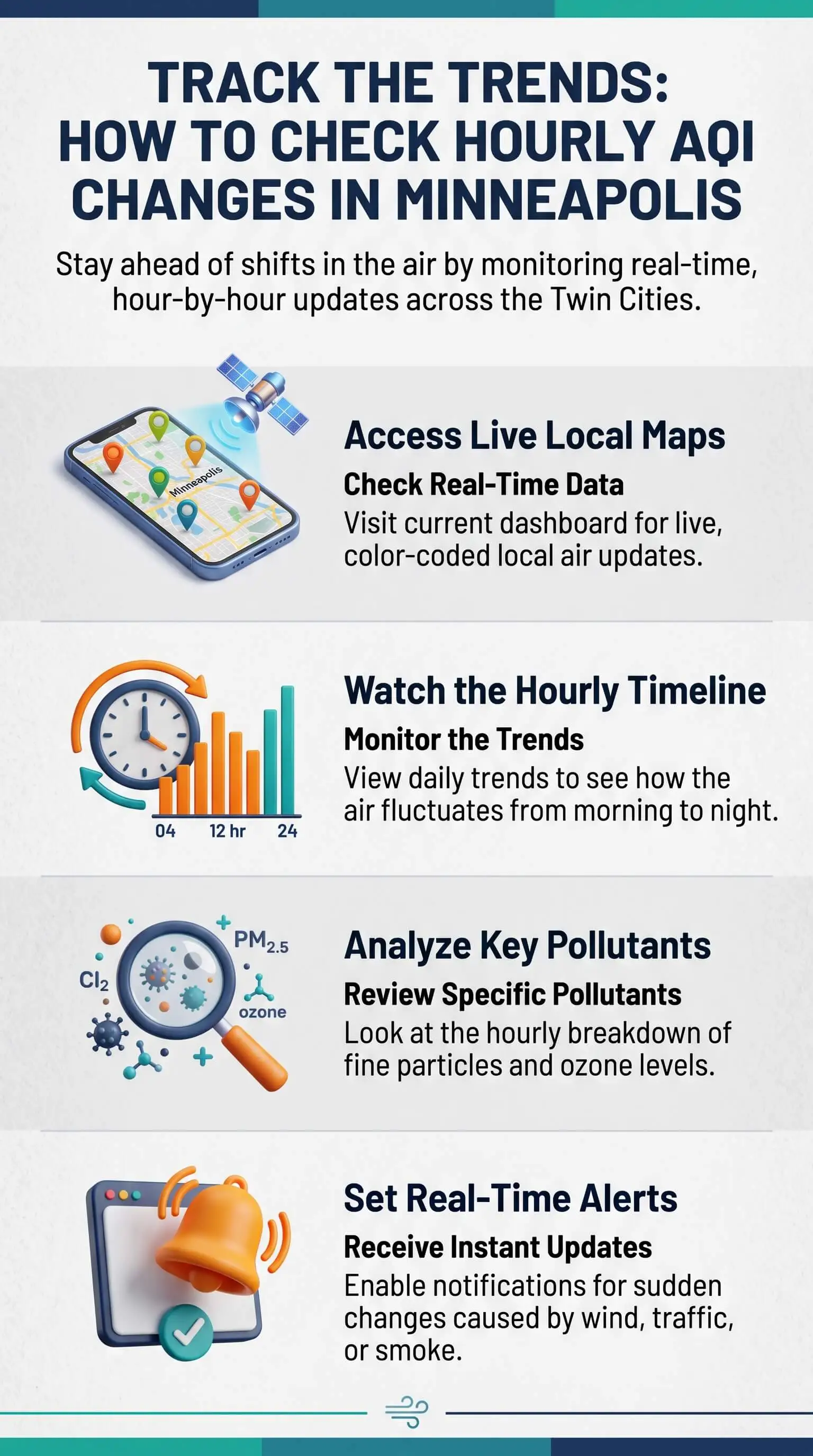
Start with the current reading. Open the live hourly AQI map for Minneapolis and note the number, its color, and which pollutant is driving it.
Glance at the day's forecast. MPCA publishes a daily air quality forecast, and an orange-or-worse call usually means the hourly number has room to climb.
Read the trend. One reading is a snapshot, so compare the last three hours. When all three tick upward, plan for worse air by the time you're done.
Size the plan to your time outside. A 20-minute dog walk and a three-hour tournament are very different exposures.
Set alerts once. Sign up for MPCA air quality alerts by email or download the AirNow app, and the bad days will come to you.
Matching Your Plans to the Hourly Reading
The Minnesota Department of Health (MDH) wrote its outdoor air guidance for schools and child care, tying limits to both the AQI and how long kids stay outside. I think it's the most practical yardstick out there for adults, too.
Good (0 to 50). Go, for as long as you like.
Moderate (51 to 100). Most people can handle a short outing without a second thought. On longer ones, keep the effort easy, and if you live with asthma or heart disease, pay attention to how you feel.
Unhealthy for Sensitive Groups (101 to 150). Keep it light, take a break every 20 minutes, and move hard workouts indoors or to another day.
Unhealthy (151 and up). Reschedule or head inside. At this level, MDH calls off all outdoor activities for kids.
Sensitive groups include children, older adults, pregnant people, and anyone with asthma, lung disease, or heart disease. If someone in your home fits that description, plan around the lower threshold. At 85, a 20-minute dog walk is fine for most people, while a 90-minute run calls for an easier pace. At 120, a sensitive teen's soccer practice should switch to light drills with frequent breaks or move into the gym.
When the Hourly AQI Climbs, Move the Plan Indoors
Most people assume the front door keeps outdoor air where it belongs. It doesn't. Fine particles work their way in around doors, through window gaps, and through fresh-air intakes, so your home only becomes a refuge when you set it up to be one.
Close windows and doors once the reading turns orange.
Flip the thermostat fan from "auto" to "on" so air keeps cycling through the filter.
Run a MERV 8 filter if your system can handle it, since it captures more of the fine particles in smoke.
Check that filter after a smoky stretch, because it can load up faster than usual.
That's a little effort for a big impact on the air your family breathes. Here's how furnace filters improve indoor air quality.
"In my experience, homes with a fresh-air intake or an energy recovery ventilator pull smoke inside faster than people expect, because that equipment is built to bring outdoor air in around the clock. On orange afternoons, I have homeowners turn their ventilation down to its lowest setting and let a MERV 13 filter clean the recirculated air until the hourly AQI drops back to yellow."
7 Essential Resources
Minneapolis Live AQI Map and Guide: today's readings, what every color means, and what pushes the city's air up and down through the year.
MPCA Current Air Quality Conditions: the state's official monitor map, plus the daily forecast and email alerts.
MDH Outdoor Air Quality Guidance for Schools and Child Care: activity limits by AQI and time outside, plus the hours when ozone and fine particles tend to peak.
City of Minneapolis Air Monitoring Dashboard: weekly neighborhood sensor data that shows which corners of the city tend to run higher.
National Weather Service: Why Air Quality Is Important: how forecasters predict ozone and particles, and what an air quality alert is asking you to do.
CDC: About Air Quality: how to plan outdoor time around the AQI, with added guidance for kids and anyone with heart or lung conditions.
EPA: Create a Clean Room During a Wildfire: a step-by-step setup for a low-smoke room at home, filtration options included.
3 Statistics
MPCA turns monitor readings into a new AQI value every hour, and it issues an air quality alert whenever it forecasts the AQI to top 100. (Minnesota Department of Health)
NowCast draws on the past 12 hours of readings and stays valid as long as 2 of the last 3 hours have data, so the current number keeps updating even when a monitor misses an hour. (AirNow Discussion Forum)
In the 2026 State of the Air report, the Minneapolis-St. Paul metro earned an F for short-term particle pollution and ranked 39th worst in the nation, while Hennepin County averaged 4.5 unhealthy particle days a year. (American Lung Association)
Minneapolis AQI readings update hourly, helping residents track changes in air pollution and prepare for unhealthy conditions. The NowCast uses data from the past 12 hours to provide a clearer picture of current air quality. In 2026, Minneapolis-St. Paul ranked 39th worst in the nation for short-term particle pollution, highlighting the need to protect indoor air from harmful particles. During periods of poor outdoor air quality, top air filters designed to capture fine particles help keep indoor air cleaner and reduce exposure to pollution at home.
Final Thoughts and Opinion
I'd put the hourly AQI right next to the hourly temperature on your phone. In Minneapolis, the air can change between breakfast and the drive home.
If I had to pick one habit, it'd be watching the trend. Three readings in a row tell you where the next hour is headed, and once you weigh that against how long you'll be outside, the right call is usually obvious. You're the one keeping watch for your household, and a few seconds is all it takes. To see how much of that outdoor air reaches your living room, an indoor air quality monitor will show you. Using high quality filters in your HVAC system helps capture fine particles and reduce indoor air pollution when outdoor AQI levels rise.
Frequently Asked Questions
How Often Does the Minneapolis AQI Update?
Every hour. MPCA converts its latest monitor readings into an AQI value each hour, and AirNow reports a NowCast that blends the past 12 hours. Forecasts come out once a day, so the current reading gives you the better picture.
Why Does My Weather App Show a Different AQI Than MPCA?
Apps pull from different places. Some rely on a nearby low-cost sensor instead of an official monitor, and some average only the last hour instead of using the NowCast blend. A small gap is normal. Use MPCA or AirNow to make the call, and treat other apps as an early heads-up for sudden local spikes.
Is It Safe to Exercise Outside When the Minneapolis AQI Is Moderate?
For most people, yes. A moderate reading of 51 to 100 carries little risk for short or easy workouts. If you have asthma, lung disease, or heart disease, keep longer sessions light and watch for coughing or shortness of breath. Everyone should back off if the hourly trend keeps climbing.
What Time of Day Is Air Quality Best in Minneapolis?
Summer mornings usually win, since ozone builds through hot afternoons and into early evening. Fine particles play by different rules and can spike any time, especially near busy roads at rush hour, on calm winter nights, and during smoke events. Checking the hourly reading beats guessing.
How Do I Get Air Quality Alerts for Minneapolis?
Sign up for MPCA air quality alerts by email, or download the EPA's AirNow app for current conditions and forecasts. MPCA issues an alert when it forecasts the AQI above 100. For more detail on a particular day, call an MPCA air quality forecaster at 651-757-2766.
Check the Hourly AQI Before Your Next Minneapolis Outing
Before your next walk, run, or practice, take a minute to check the hourly AQI in Minneapolis, see which way it's moving, and match it to how long you'll be outside. That small habit keeps the air you can't see from making decisions for your family. Learning how to change your furnace filter helps keep your indoor air cleaner when outdoor pollution levels rise.